
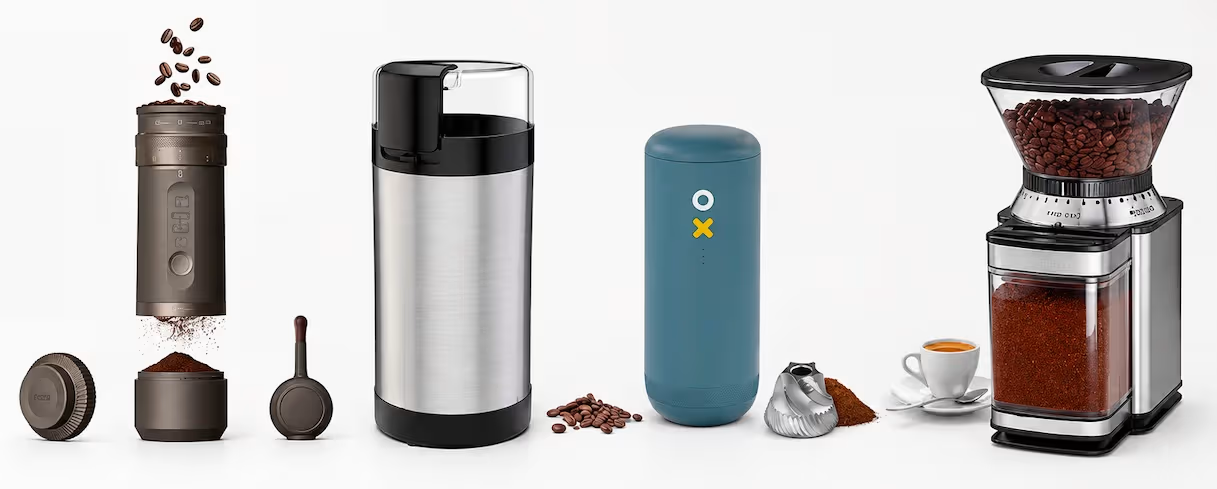
While blade grinders can produce a wide range of particle sizes, burr grinders are designed to provide more controlled and repeatable grind settings for different brewing methods.
In this guide, we compare seven popular electric burr grinders for home use, from filter-focused models to espresso-oriented and single-dose options. Our selections are based on product specifications, burr design, grind adjustment, brewing compatibility, workflow, maintenance considerations, manufacturer information, and available third-party product information.
Quick Comparison: 7 Electric Burr Grinders
| Grinder | Burr Type | Best For | Standout Feature |
|---|---|---|---|
| Fellow Ode Gen 2 | 64mm flat steel | Pour-over & filter | Anti-static technology |
| Baratza Sette 270 | Conical steel | Espresso | Macro/micro adjustment |
| Baratza Encore | 40mm conical steel | Beginners | Simple, repairable design |
| Breville Smart Grinder Pro | Conical steel | Multiple brew methods | Programmable dosing |
| Mahlkönig X54 | 54mm flat steel | Premium home setup | Broad brewing range |
| OXO Brew Conical Burr Grinder | Conical steel | Budget filter brewing | Simple timed grinding |
| DF64 Gen 2 | 64mm flat steel | Single dosing | Low-retention workflow |
How We Selected These Electric Burr Grinders
We evaluated these grinders as a research-based comparison rather than a hands-on laboratory test.
Our selection considers burr type and size, grind adjustment, compatibility with different brewing methods, dosing workflow, grind retention, static management, ease of cleaning and maintenance, manufacturer support, and overall value.
Product specifications, availability, and features can change over time. Readers should confirm current specifications with the manufacturer or retailer before purchasing.
The 7 Best Electric Burr Grinders of 2026
1. Fellow Ode Gen 2 – Best for Filter Coffee
The Fellow Ode Gen 2 is primarily designed for home brewers who use pour-over, automatic drip, French press, and other filter methods.
Its 64mm flat burr system provides a broad range of settings for filter brewing, while its anti-static technology is intended to reduce the amount of coffee grounds and chaff that cling to the grinder or surrounding work surface.
Its single-dose-oriented design may also appeal to people who prefer weighing each dose rather than storing a large quantity of beans in a hopper.
Best For: Pour-over, drip, French press, and other filter-coffee drinkers.
Pros:
- 64mm flat burrs
- Anti-static technology
- Single-dose-oriented workflow
- Compact design for home use
Cons:
- Primarily designed for filter brewing
- Not the most suitable choice for users whose main priority is traditional espresso grinding
Check Fellow Ode Gen 2 on Amazon
2. Baratza Sette 270 – Best for Espresso-Focused Brewing
The Baratza Sette 270 is designed primarily for espresso-focused users who need relatively fine control over grind adjustment.
Its adjustment system combines macro and micro settings, allowing users to make smaller changes when dialing in espresso.
The Sette design also uses a distinctive burr-drive configuration in which the outer burr rotates while the inner burr remains stationary.
For users who regularly change beans or espresso recipes, the adjustment system is one of the Sette 270’s most relevant features.
Best For: Home espresso users who frequently adjust grind settings.
Pros:
- Macro and micro grind adjustment
- Espresso-oriented design
- Fast dosing workflow
- Suitable for users who frequently dial in different coffees
Cons:
- Operating noise may be a drawback for users seeking a quieter grinder
- More specialized toward espresso than some general-purpose alternatives
Check Baratza Sette 270 on Amazon
3. Baratza Encore – Best Entry-Level Option
The Baratza Encore is a straightforward electric burr grinder aimed at users moving from blade grinding or pre-ground coffee into more controlled home grinding.
It uses 40mm conical burrs and provides multiple grind settings suitable for common filter-brewing methods.
One advantage of the Encore platform is its relatively simple design. Baratza also provides replacement parts and maintenance information for many of its grinders, which can be useful for owners interested in longer-term serviceability.
Best For: Beginners and home brewers who mainly prepare filter coffee.
Pros:
- Straightforward controls
- 40mm conical burr system
- Replacement parts and maintenance support
- Suitable for several common filter methods
Cons:
- Limited dosing automation
- Users focused primarily on espresso may prefer a grinder with finer adjustment control
Check Baratza Encore on Amazon
4. Breville Smart Grinder Pro – Best for Versatility
The Breville Smart Grinder Pro is designed for users who want one grinder capable of supporting several brewing methods.
Its digital interface allows users to select grind settings and adjust timed dosing in small increments. This can make repeatable daily preparation easier for users who prefer an electronically controlled workflow.
The hopper system also allows beans to be stored directly in the grinder, making it convenient for households that regularly use the same coffee.
Best For: Home users who switch between espresso, drip, and other brewing methods.
Pros:
- Digital interface
- Programmable timed dosing
- Wide range of grind settings
- Large hopper for everyday use
Cons:
- Hopper-based design is less suited to users who frequently switch between different beans
- Dedicated espresso enthusiasts may prefer a more specialized grinder
Check Breville Smart Grinder Pro on Amazon
5. Mahlkönig X54 – Premium Pick
The Mahlkönig X54 brings the manufacturer’s grinder experience into a machine designed specifically for home use.
It uses 54mm flat steel burrs and is intended to accommodate a relatively broad range of brewing methods, including espresso and filter coffee.
This makes the X54 relevant to users who want a premium grinder without necessarily purchasing separate machines for different brewing styles.
Best For: Home coffee enthusiasts looking for a premium multi-purpose grinder.
Pros:
- 54mm flat steel burrs
- Supports multiple brewing methods
- Designed for home use
- Grind-by-time functionality
Cons:
- Higher purchase price than many entry-level grinders
- Larger investment may not be necessary for casual coffee drinkers
6. OXO Brew Conical Burr Grinder – Budget-Friendly Pick
The OXO Brew Conical Burr Grinder is aimed at users who want the consistency advantages of a burr grinder without moving immediately into higher-priced enthusiast equipment.
Its conical burr system and straightforward controls make it particularly suitable for common home filter-brewing methods.
The integrated timer can also simplify repeatable daily grinding.
Best For: Budget-conscious users upgrading from a blade grinder or pre-ground coffee.
Pros:
- Straightforward operation
- Conical burr system
- Integrated timer
- Practical for everyday filter brewing
Cons:
- Grind adjustment may be less precise for demanding espresso workflows
- Fewer advanced controls than enthusiast-oriented grinders
Check OXO Brew Conical Burr Grinder on Amazon
7. DF64 Gen 2 – Best for Single-Dose Workflows
The DF64 Gen 2 is designed around a single-dose workflow. Instead of keeping beans in a large hopper, users can weigh an individual dose before grinding.
Its 64mm flat burr format and low-retention-oriented design make this type of grinder particularly relevant to enthusiasts who frequently change coffees or brewing recipes.
The Gen 2 also incorporates static-control features intended to reduce mess during grinding.
Best For: Coffee enthusiasts who weigh individual doses and frequently switch beans.
Pros:
- 64mm flat burr format
- Single-dose workflow
- Low-retention-oriented design
- Static-control system
Cons:
- Workflow may be more involved than a traditional hopper grinder
- Enthusiast-oriented design may be unnecessary for users seeking simple one-button operation
Why a Burr Grinder Matters for Coffee Extraction
Coffee brewing involves water dissolving soluble compounds from ground coffee. Grind size and particle distribution influence how quickly that extraction occurs.
A grinder that provides repeatable adjustment makes it easier to adapt the grind to different brewing methods and make controlled changes when coffee tastes under- or over-extracted.
The Problem With Blade Grinders
Blade grinders use a rapidly rotating blade to break coffee beans apart.
Because the beans move freely inside the grinding chamber, the resulting particles can vary considerably in size. Some pieces may remain relatively large while others become much finer.
That variation can make extraction more difficult to control.
If you’re also considering a simpler blade grinder, see our guide to the 5 Best Electric Coffee Blade Grinders.
How Particle Distribution Affects Brewing
Smaller coffee particles generally extract more quickly than larger particles because they expose more surface area relative to their volume.
If a grind contains a very broad range of particle sizes, different particles may extract at different rates during the same brew.
Burr grinders pass coffee through a controlled gap between grinding surfaces. Changing that gap allows users to adjust the approximate grind size for espresso, pour-over, French press, and other brewing methods.
The goal is not to produce particles that are literally identical, but to achieve a sufficiently controlled distribution for repeatable brewing.
Conical Burr vs. Flat Burr: What’s the Difference?
Electric coffee grinders commonly use either conical or flat burr systems.
Neither design is automatically superior in every application. Burr geometry, alignment, motor speed, grinder construction, grind setting, coffee characteristics, and brewing method can all influence the resulting grind and cup.
Conical Burrs
A conical burr system typically consists of a cone-shaped inner burr operating within an outer ring burr.
Conical systems are widely used in both home and commercial grinders and can be found across a broad range of price levels.
They are often selected for compact grinder designs and can support many brewing methods depending on the particular grinder and burr geometry.
Flat Burrs
Flat burr grinders use two approximately parallel burrs with cutting surfaces facing one another.
They are common in both commercial and enthusiast-oriented grinders. Larger flat-burr platforms can also provide different burr geometries optimized for particular grinding applications.
Rather than choosing solely between flat and conical burrs, consider the specific grinder, burr design, adjustment system, and intended brewing method.
Key Features to Consider When Buying an Electric Burr Grinder
Burr Type and Size
Burr material, geometry, diameter, alignment, and grinder design can all affect grinding performance.
Steel burrs are widely used in electric home grinders, while ceramic burrs also appear in some designs.
Burr material alone should not be treated as an indication that one grinder will necessarily produce better-tasting coffee than another.
Grind Adjustment
Think about the brewing methods you actually use.
Filter brewing generally does not require the same fine adjustment resolution as espresso. Espresso users often benefit from smaller adjustment increments because relatively small grind changes can influence shot time and flow.
Static Management
Freshly ground coffee can accumulate static electricity, causing fine particles and chaff to cling to surfaces.
Some newer grinders incorporate ionizers, plasma systems, or other static-management features designed to reduce this problem.
Hopper vs. Single Dosing
A hopper is convenient if you regularly use the same coffee and want beans ready for daily grinding.
Single dosing may be preferable if you frequently change coffees, alternate between regular and decaffeinated beans, or weigh each dose as part of your brewing routine.
Grind Retention
Retention refers to coffee remaining inside the grinder after grinding.
Lower retention can be particularly useful when switching coffees or making frequent grind adjustments. For everyday hopper-based brewing, however, convenience may matter more than achieving the lowest possible retention.
Cleaning and Maintenance
Coffee oils and fine particles accumulate inside grinders over time.
Before purchasing, consider how easily the burr chamber can be accessed, whether replacement parts are available, and what maintenance procedures the manufacturer recommends.
Which Electric Burr Grinder Should You Choose?
There is no single grinder that is ideal for every home coffee setup.
If you mainly brew pour-over or filter coffee, a filter-focused grinder such as the Fellow Ode Gen 2 may fit your workflow.
If espresso is your primary brewing method, finer adjustment capability becomes more important, which is where an espresso-oriented grinder such as the Baratza Sette 270 becomes relevant.
For beginners seeking a straightforward entry into burr grinding, the Baratza Encore or OXO Brew may be easier starting points.
Users who frequently change coffees may prefer the single-dose workflow of the DF64 Gen 2, while those wanting one grinder for several brewing methods can consider multi-purpose models such as the Breville Smart Grinder Pro or Mahlkönig X54.
The best choice ultimately depends on your brewing method, workflow, adjustment requirements, available counter space, and budget.
Frequently Asked Questions
Are burr grinders better than blade grinders?
Burr grinders generally provide more control over grind size because coffee passes through an adjustable gap between burrs. Blade grinders chop beans with a rotating blade, which can result in a broader range of particle sizes.
For users who want greater repeatability across different brewing methods, a burr grinder is generally the more controllable option.
Do I need a different grinder for espresso?
Not necessarily, but espresso typically benefits from finer adjustment resolution than most filter-brewing methods.
A multi-purpose grinder may work for both, while users who prepare espresso frequently may prefer a grinder designed specifically around espresso adjustment and dosing.
Are flat burrs better than conical burrs?
Not universally.
Burr geometry is only one part of grinder performance. Alignment, motor design, rotational speed, adjustment mechanism, burr size, coffee, and brewing method can also affect results.
Choose the grinder as a complete system rather than selecting solely by burr shape.
What does low retention mean?
Low retention means relatively little ground coffee remains inside the grinder after a dose has been ground.
This can be useful when switching between coffees or changing grind settings frequently.
Is a single-dose grinder better than a hopper grinder?
It depends on workflow.
Single dosing is useful for people who weigh every dose or frequently change beans. A hopper grinder can be more convenient for users who make the same coffee every day.
Conclusion
Choosing among the best electric burr grinders ultimately comes down to your brewing method, workflow, and budget. An electric burr grinder can provide greater control and repeatability than a basic blade grinder, but the right model depends on how you make coffee.
Rather than choosing a grinder solely because it has larger burrs, more settings, or a higher price, consider how its adjustment system and workflow fit your preferred brewing method.
For filter-focused brewing, espresso, multi-purpose use, or single dosing, the seven grinders above represent different approaches to home coffee preparation. Compare those differences against your own brewing habits before deciding which features are worth paying for.

My name is Kara Chavez, and I’m a coffee writer and researcher at MTN Lyon Cafe.
I’m interested in coffee equipment, brewing methods, espresso, coffee beans, and practical ways to make better coffee at home. My work focuses on researching product information, comparing features, reviewing third-party testing and consumer feedback, and turning that information into clear, useful guides for coffee lovers.
At MTN Lyon Cafe, I aim to help readers better understand coffee products, improve their brewing knowledge, and make more informed purchasing decisions.