
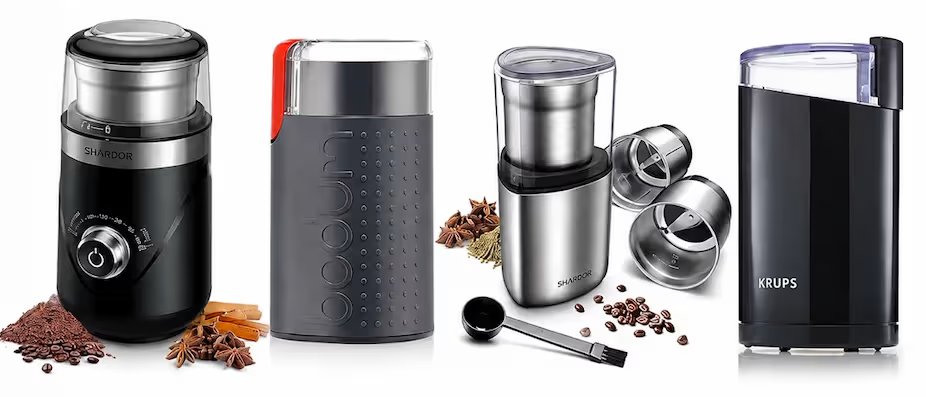
The best electric coffee blade grinders offer a simple and affordable way to grind whole coffee beans at home. They are compact, easy to operate, and can be a practical choice for casual coffee drinkers who do not need the precise grind adjustment of a burr grinder.
Unlike burr grinders, blade grinders use a rapidly rotating blade to chop coffee beans. This means particle size can vary more from one grind to another, but techniques such as pulsing the grinder and gently shaking it between pulses can help improve consistency.
In this guide, we compare five popular electric blade grinders based on product specifications, design, capacity, controls, cleaning convenience, safety features, and suitability for everyday home use. This is a research-based comparison rather than a hands-on laboratory test.
Quick Comparison: 5 Electric Coffee Blade Grinders
| Grinder | Best For | Bowl Design | Standout Feature |
|---|---|---|---|
| SHARDOR One-Touch Coffee Grinder | Everyday use | Removable stainless-steel bowl | Simple operation |
| Hamilton Beach Fresh Grind | Easy cleaning | Removable chamber | Easy pouring and cleanup |
| KRUPS Precision Grinder | Small kitchens | Integrated bowl | Compact design |
| Secura Coffee & Spice Grinder | Multipurpose use | Removable bowls | Coffee and spice versatility |
| Cuisinart Grind Central DCG-12BC | Larger batches | Removable bowl | Capacity and measurement markings |
How We Selected These Blade Grinders
This guide is a research-based product comparison rather than a hands-on test.
We considered factors that matter for everyday blade-grinder use, including bowl design, controls, capacity, cleaning convenience, storage, versatility, safety features, and suitability for different home-coffee routines.
We also considered an important limitation shared by blade grinders: grind size is controlled primarily through grinding time and technique rather than a calibrated burr adjustment system.
Product specifications and availability can change over time, so readers should confirm current information with the manufacturer or retailer before purchasing.
The 5 Best Electric Coffee Blade Grinders of 2026
1. SHARDOR One-Touch Coffee Grinder — Versatile Everyday Pick
The SHARDOR One-Touch Coffee Grinder is designed around straightforward operation and a removable stainless-steel grinding bowl.
Rather than selecting a calibrated grind setting, users control the approximate texture through grinding time and short pulses. The removable bowl can make transferring grounds and cleaning more convenient than designs with a permanently integrated grinding chamber.
Its multipurpose design may also appeal to households that occasionally grind dry ingredients in addition to coffee.
Best For: Everyday home use and users who prioritize easy cleanup.
Pros:
- Simple operation
- Removable grinding bowl
- Stainless-steel blade
- Compact countertop footprint
- Can accommodate some dry-ingredient grinding
Cons:
- No calibrated grind-size adjustment
- Consistency depends partly on technique
- Less controlled than a burr grinder
Check SHARDOR One-Touch Coffee Grinder on Amazon
2. Hamilton Beach Fresh Grind — Convenient for Easy Cleanup
The Hamilton Beach Fresh Grind is particularly relevant to users who value a removable grinding chamber.
After grinding, the chamber can be removed for transferring the grounds rather than requiring users to pour directly from the grinder body. This can simplify both serving and cleaning.
Its compact format also makes it suitable for kitchens where storage or counter space is limited.
As with other blade grinders, short pulses provide more control than simply running the motor continuously.
Best For: Daily coffee drinkers who prioritize straightforward operation and cleaning.
Pros:
- Removable grinding chamber
- Compact design
- Straightforward controls
- Easy transfer of grounds
Cons:
- No dedicated grind-size settings
- Requires manual pulsing
- Not designed for precise espresso adjustment
Check Hamilton Beach Fresh Grind on Amazon
3. KRUPS Precision Grinder — Compact Pick
The KRUPS Precision Grinder is a compact blade grinder for users who want basic coffee grinding without a large appliance occupying the countertop.
Its operation is straightforward: add the beans and control grinding time manually. Short pulses can help users monitor the developing particle size.
The compact body is particularly relevant for apartments, smaller kitchens, or coffee stations where storage space matters.
Depending on the specific model, the integrated grinding chamber can require more careful cleaning than a removable bowl, so buyers should verify the configuration of the current product before purchasing.
Best For: Small kitchens and users seeking a simple, compact grinder.
Pros:
- Compact footprint
- Straightforward operation
- Stainless-steel blade
- Easy to store
Cons:
- Manual control of grind time
- Integrated bowl can be less convenient to clean
- No calibrated grind settings
Check KRUPS Precision Coffee Grinder on Amazon
4. Secura Electric Coffee and Spice Grinder — Multipurpose Pick
The Secura Electric Coffee and Spice Grinder is aimed at users who want one small appliance for coffee and other dry ingredients.
Configurations with separate removable bowls are particularly useful because coffee and strongly aromatic spices can otherwise share residual flavors and aromas.
This makes the Secura especially relevant to households where the grinder will be used as a general kitchen appliance rather than exclusively for coffee.
Users should still verify the exact accessories included with the current model because product configurations can vary.
Best For: Home cooks who want to grind both coffee and dry ingredients.
Pros:
- Multipurpose design
- Removable bowl configuration
- Easier ingredient transfer
- Useful for coffee and kitchen preparation
Cons:
- Additional components require storage
- Manual grind control
- Not intended for precision espresso grinding
Check Secura Coffee and Spice Grinder on Amazon
5. Cuisinart Grind Central DCG-12BC — Larger-Batch Pick
The Cuisinart Grind Central DCG-12BC is designed for users who want to grind larger quantities than they might prepare in a very small blade grinder.
Its removable stainless-steel bowl and measurement markings can make preparing and transferring a larger batch more convenient. A storage lid can also be useful when grounds need to be held briefly before brewing.
However, grinding only the quantity you expect to brew soon generally makes more sense for preserving coffee aroma than routinely storing pre-ground coffee.
Best For: Families, shared kitchens, and larger drip-coffee batches.
Pros:
- Removable stainless-steel bowl
- Measurement markings
- Suitable for larger batches
- Convenient transfer and storage features
Cons:
- Larger than some compact blade grinders
- Grind consistency depends on timing and technique
- No calibrated grind-size adjustment
Check Cuisinart Grind Central DCG-12BC on Amazon
How to Choose an Electric Coffee Blade Grinder
A blade grinder does not need a long list of advanced features to be useful. What matters is whether its design matches the way you prepare coffee.
Capacity
Consider how much coffee you normally brew at one time.
A compact grinder may be sufficient for one or two people, while a larger bowl can be more convenient for full pots or shared households.
Avoid choosing solely on maximum capacity. Grinding only what you need for your immediate brewing routine can help limit unnecessary exposure of ground coffee to air.
Removable vs. Fixed Bowl
A removable grinding bowl can make transferring grounds and cleaning easier.
Fixed-bowl designs can be simpler and more compact but usually require cleaning the chamber while it remains attached to the appliance.
If convenience is a priority, bowl design deserves as much consideration as motor power or appearance.
Controls
Many blade grinders use a simple push-button or press-and-hold control.
Because there is no calibrated burr gap, grind texture is influenced largely by how long the grinder runs.
Short pulses provide more opportunity to inspect the grounds and stop when the approximate texture suits your brewing method.
Coffee-Only vs. Multipurpose Use
Some blade grinders are marketed for both coffee and spices.
If you intend to use the same appliance for both, separate removable bowls can be helpful because strongly aromatic spices may leave residues or odors behind.
A dedicated coffee grinder may be preferable if avoiding flavor transfer is important to you.
Cleaning and Maintenance
Coffee oils and fine particles accumulate inside grinders.
Check the manufacturer’s cleaning instructions before washing any component. Removable components may be easier to clean, but not every removable part is necessarily dishwasher-safe.
How to Get More Consistent Results From a Blade Grinder
Blade grinders inherently provide less direct control over particle size than burr grinders, but technique can still make a difference.
Use short pulses rather than one long continuous grind. Between pulses, gently shake or reposition the grinder if permitted by the manufacturer’s instructions. This can redistribute larger bean fragments toward the blade.
Check the grounds frequently rather than relying solely on grinding time.
Try to use a similar quantity of beans each time. A repeatable dose and grinding routine can make results more predictable.
Most importantly, recognize the limitations of the equipment. A blade grinder can be practical for casual brewing, but it is not a substitute for a grinder with calibrated burr adjustment when precise grind control is required.
Blade Grinder vs. Burr Grinder
The fundamental difference is the way the coffee is processed.
A blade grinder chops coffee beans using a rapidly rotating blade, while a burr grinder passes beans between grinding surfaces separated by an adjustable gap.
| Factor | Blade Grinder | Burr Grinder |
|---|---|---|
| Typical cost | Lower | Higher |
| Operation | Simple | More adjustable |
| Grind-size control | Primarily time/technique | Adjustable burr spacing |
| Particle distribution | Generally broader | Generally more controlled |
| Size | Often compact | Varies |
| Good fit for | Casual everyday grinding | Repeatable brewing and greater grind control |
Blade grinders can therefore make sense for users prioritizing price, compact size, and simplicity.
Burr grinders become more relevant when repeatability and precise grind adjustment are priorities, particularly when working across different brewing methods or dialing in espresso.
If you want greater control over grind size, see our guide to the 7 Best Electric Burr Grinders for Home Brewing.
This creates a useful connection between the two types of grinder rather than treating one as universally appropriate for every coffee drinker.
Frequently Asked Questions
Are electric blade grinders good for coffee?
They can be practical for casual home brewing, particularly when affordability, compact size, and simple operation are priorities.
Their main limitation is that they provide less direct control over particle size than burr grinders.
How long should I grind coffee in a blade grinder?
There is no universal grinding time because the result depends on the grinder, amount of coffee, blade design, and desired texture.
Use short pulses and inspect the grounds regularly instead of relying on a fixed number of seconds.
Can a blade grinder produce coarse coffee grounds?
A shorter grinding time can leave a coarser overall texture, but a blade grinder does not produce a calibrated coarse setting in the same way as a burr grinder.
Expect a broader range of particle sizes.
Can I use a blade grinder for French press?
A blade grinder can be used when preparing coffee for a French press, but controlling coarse grind consistency can be challenging.
Users seeking more repeatable French press grinding may prefer a burr grinder with an adjustable coarse setting.
Can I grind spices in a coffee blade grinder?
Some manufacturers specifically design their grinders for both coffee and spices.
Check the manufacturer’s instructions for your particular model. If possible, use separate bowls for coffee and strongly aromatic spices to reduce flavor transfer.
Is a blade grinder suitable for espresso?
A blade grinder can make coffee relatively fine, but fineness alone is not the main requirement for espresso.
Espresso typically benefits from small, repeatable adjustments to grind size. A suitable burr grinder generally provides substantially more control for this purpose.
Conclusion
The best electric coffee blade grinders are most useful when simplicity, compact size, and affordability matter more than precise grind adjustment.
The five grinders in this guide take different approaches to everyday use. SHARDOR emphasizes a removable-bowl workflow, Hamilton Beach focuses on convenient handling, KRUPS offers a compact format, Secura targets multipurpose kitchen use, and the Cuisinart Grind Central provides a larger-batch option.
Rather than choosing solely on price or motor specifications, consider bowl design, cleaning, capacity, storage, and whether you need a dedicated coffee grinder or a multipurpose appliance.
For casual home brewing, a blade grinder may be sufficient. If you eventually want more repeatable grind settings or greater control over extraction, moving to an adjustable burr grinder is the logical next step.

My name is Kara Chavez, and I’m a coffee writer and researcher at MTN Lyon Cafe.
I’m interested in coffee equipment, brewing methods, espresso, coffee beans, and practical ways to make better coffee at home. My work focuses on researching product information, comparing features, reviewing third-party testing and consumer feedback, and turning that information into clear, useful guides for coffee lovers.
At MTN Lyon Cafe, I aim to help readers better understand coffee products, improve their brewing knowledge, and make more informed purchasing decisions.