
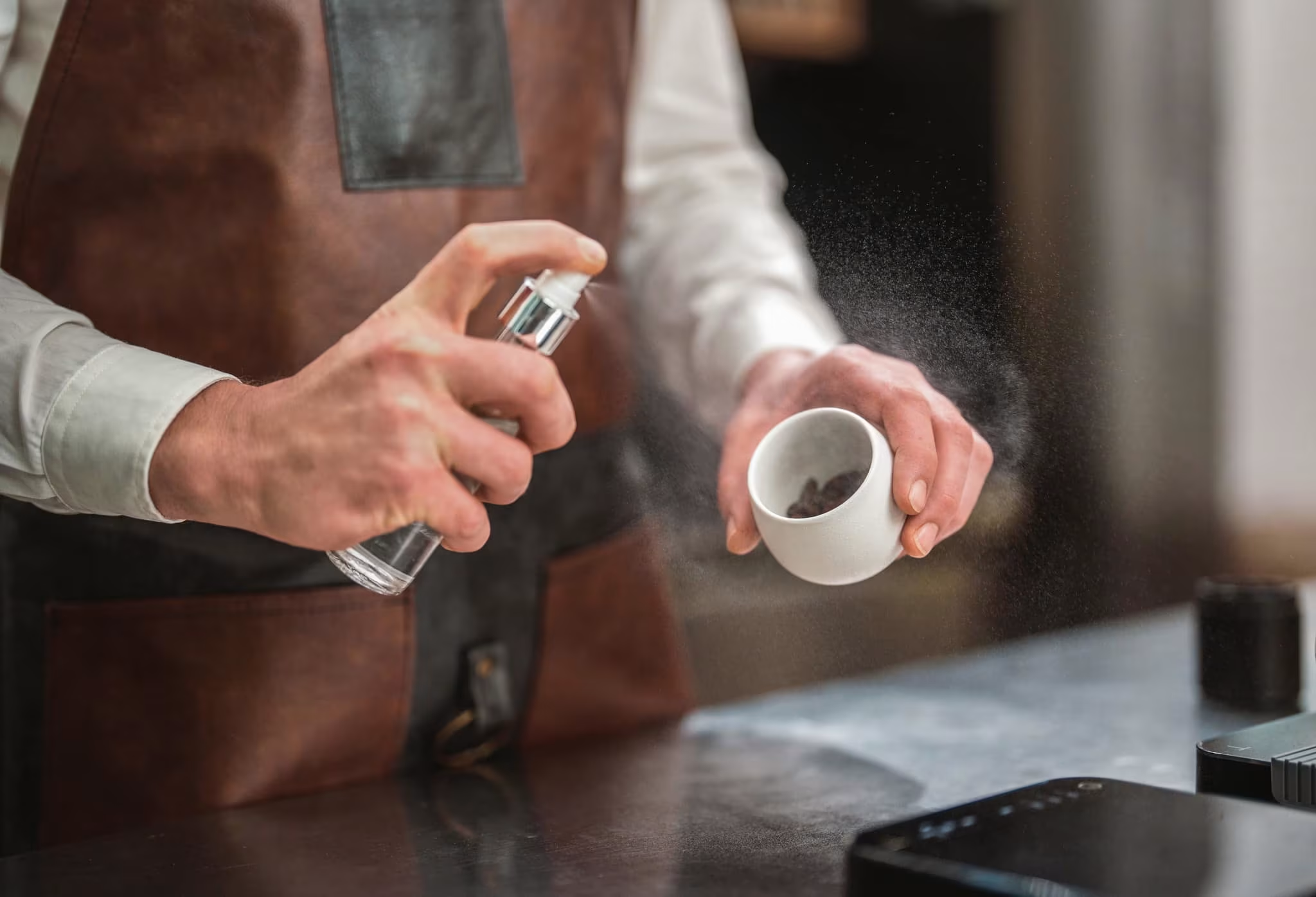
Many coffee enthusiasts ask, why do many people spray water on coffee beans before grinding them? This practical guide explains the science behind the Ross Droplet Technique, how it reduces static electricity, improves grind consistency, and enhances flavor extraction. You’ll learn when to use it, how it impacts espresso and filter brewing, and whether it truly makes a difference in daily coffee routines. By understanding why do many people spray water on coffee beans before grinding them, you can refine your workflow, reduce mess, and brew more consistent coffee at home or in professional settings.
Why Spray Water on Coffee Beans Before Grinding?
Coffee culture in the United States has evolved far beyond simple drip brewing, and curious home baristas are constantly experimenting with small workflow adjustments that promise measurable improvements in flavor, consistency, and equipment handling. One of the most discussed questions in modern brewing circles is why do many people spray water on coffee beans before grinding them?
At first glance, misting roasted beans with water sounds counterintuitive — coffee professionals spend enormous effort controlling moisture during roasting and storage — yet this technique has quietly become a staple among specialty coffee enthusiasts, espresso competitors, and meticulous home brewers. Understanding why do many people spray water on coffee beans before grinding them requires unpacking the physics of coffee grinding static reduction, examining extraction science, and exploring the workflow benefits of what is commonly known as the Ross Droplet Technique (RDT).
By exploring this topic through practical insight, scientific grounding, and real-world application, readers gain a clearer sense of how minor process adjustments influence sensory outcomes in the cup, demonstrating that precision and curiosity often separate routine brewing from refined craft coffee preparation.
Why Do Many People Spray Water on Coffee Beans Before Grinding Them?
The core answer to why do many people spray water on coffee beans before grinding them lies in static electricity and particle behavior during grinding. When roasted beans pass through a burr grinder, friction creates electrostatic charge that causes fine particles to cling to chute walls, scatter across counters, or remain trapped within the grinder. This phenomenon directly impacts dose accuracy, grind consistency, and workflow cleanliness.
Applying a light mist of water — typically one or two droplets — neutralizes static charge and stabilizes particle distribution. The result is cleaner grounds transfer, reduced retention, and improved espresso grind consistency or filter uniformity. Coffee professionals emphasize that this method is not about altering bean chemistry but about controlling physical interactions. Consider the following functional outcomes widely reported across cafés and home setups:
- Reduced mess: Fewer airborne fines and stray particles
- Improved dosing accuracy: Less coffee retained in grinder pathways
- Enhanced extraction repeatability: More consistent particle size distribution
- Better workflow ergonomics: Faster cleanup and predictable preparation
“Small adjustments compound into significant sensory differences — controlling grind physics improves cup reliability.”
From Seattle micro-roasteries to Brooklyn espresso bars, the question of why do many people spray water on coffee beans before grinding them continues to gain attention because it aligns with a broader shift toward process optimization in specialty coffee preparation.
Static Electricity and Coffee Grinding Explained
Static charge emerges naturally during coffee grinding due to triboelectric interaction between burr surfaces and brittle roasted beans. As grinding speed increases and humidity drops — particularly during winter in dry climates — particle agitation intensifies electrostatic buildup. This leads to recognizable symptoms:
| Grinding Condition | Resulting Effect | Brewing Consequence |
|---|---|---|
| Low humidity environment | Increased static | Grounds cling and scatter |
| High burr speed | Particle friction surge | Uneven distribution |
| Dark roast brittleness | More fines produced | Extraction imbalance |
| Dry storage conditions | Charge accumulation | Messy workflow |
| These effects illustrate the scientific basis behind coffee grinding static reduction and clarify why do many people spray water on coffee beans before grinding them. Moisture molecules act as conductive bridges, dissipating accumulated charge before beans enter the burr set. This small intervention reduces airborne particles, stabilizes dose weight, and contributes to repeatable grind performance — a principle grounded in electrostatics rather than brewing folklore. |
The Ross Droplet Technique (RDT) Overview
Among specialty coffee communities, the practice is formalized as the Ross Droplet Technique, named after a coffee enthusiast who documented the method in online espresso forums in the early 2000s. Though informal in origin, RDT has gained acceptance across professional and enthusiast contexts due to reproducible outcomes. Its core premise remains simple: apply minimal water to beans immediately before grinding to reduce static.
Origins in Espresso Communities
The spread of Ross Droplet Technique (RDT) demonstrates how grassroots innovation influences professional workflows. Early adoption occurred in online communities discussing single-dosing grinders and retention minimization. Over time, barista competition training environments incorporated the technique to improve grind distribution precision. Today, RDT discussion appears across trade events, brewing workshops, and specialty roaster training sessions — reflecting broader recognition of micro-optimization in brewing methodology.
How Moisture Neutralizes Static Charge
From a physics perspective, water molecules facilitate charge equalization by increasing surface conductivity. Even microscopic moisture presence allows electrons to redistribute across bean surfaces rather than accumulate in localized zones. This mechanism explains why do many people spray water on coffee beans before grinding them without significantly altering roast integrity or flavor composition. Key interactions include:
- Charge redistribution across bean surfaces
- Reduced particle repulsion during burr exit
- Lower fine particle adherence to equipment walls
- Stabilized grounds flow into dosing containers
Such insights reinforce how seemingly small procedural adjustments intersect with deeper coffee brewing science, highlighting the value of process literacy among serious brewers.
How Spraying Water Improves Grind Consistency and Extraction
Understanding why do many people spray water on coffee beans before grinding them also requires linking grind uniformity to extraction chemistry. Extraction efficiency depends on particle size distribution; inconsistent grinding generates uneven surface area exposure, resulting in simultaneous over- and under-extraction. By reducing static-driven clumping and dispersion irregularities, RDT promotes stable grounds geometry, which contributes to balanced solute dissolution.
Particle Distribution and Channeling
In espresso preparation, uneven particle clusters encourage channel formation within the puck, producing localized flow acceleration and incomplete extraction. Improved distribution following coffee grinding static reduction reduces channel probability and supports stable pressure resistance. Observable benefits include:
- More uniform espresso flow dynamics
- Balanced flavor intensity
- Reduced shot variability across repeated pulls
- Greater reliability in dialing grind settings
For filter brewing, improved distribution yields clearer cup profiles and predictable flow rates — illustrating cross-method relevance of the technique.
Read more: Best Coffee Makers: Top Picks for Perfect Brews
Impact on Flavor Clarity and Balance
Although spraying water does not directly alter bean chemistry, indirect effects on grind homogeneity influence sensory perception. Brewers frequently report improvements in:
- Flavor clarity
- Sweetness perception
- Acidity definition
Aroma articulation
These outcomes connect workflow control with sensory payoff — a key benefit dimension in the CANABIS persuasion model — demonstrating that understanding why do many people spray water on coffee beans before grinding them supports measurable cup quality improvements rather than superficial ritual.
Espresso vs Pour-Over Results
| Brew Method | Observed RDT Impact | Sensory Outcome |
|---|---|---|
| Espresso | Reduced channeling | Fuller body |
| Pour-over | Stable flow bed | Cleaner acidity |
| AeroPress | Uniform extraction | Balanced sweetness |
| French press | Minimal effect | Limited change |
| This comparative perspective provides actionable insight for readers evaluating technique relevance within their brewing context. |
When Should You Spray Water on Coffee Beans?
Not every scenario requires intervention, and understanding why do many people spray water on coffee beans before grinding them includes recognizing situational relevance. The technique proves most valuable under conditions characterized by static risk or retention sensitivity.
Best Scenarios for Home Brewers
- Single-dose grinding workflows
- Dry winter climates
- Light roast brittle beans
- Precision espresso preparation
- Mess-sensitive kitchen environments
Situations Where It May Not Help
- High-humidity regions
- Integrated commercial anti-static grinders
- Large batch grinding contexts
Immersion brewing with coarse grind tolerance
Balanced guidance enhances reader trust and authority alignment — reinforcing credibility through nuanced recommendation rather than universal prescription.
Conclusion
Ultimately, answering why do many people spray water on coffee beans before grinding them reveals broader themes extending beyond static electricity mitigation. The practice reflects curiosity, experimentation, and pursuit of incremental excellence — values deeply embedded within specialty coffee culture across North America and beyond. When applied correctly, the technique delivers:
- Cleaner grinding workflow
- Reduced retention variability
- Improved grind distribution
- Enhanced extraction stability
- Greater preparation confidence

My name is Kara Chavez, and I love coffee. I love making the best coffees – espresso, latte, macchiato. I always strive for perfection in my barista skills, and I take great pride in bringing delicious cups of coffee to my customers.
I’ve been in the coffee industry for many years, and I know everything there is to know about brewing the perfect cup of coffee. My passion for coffee shines through in every cup I make, and I hope you’ll stop by soon so I can share my love of coffee with you!